
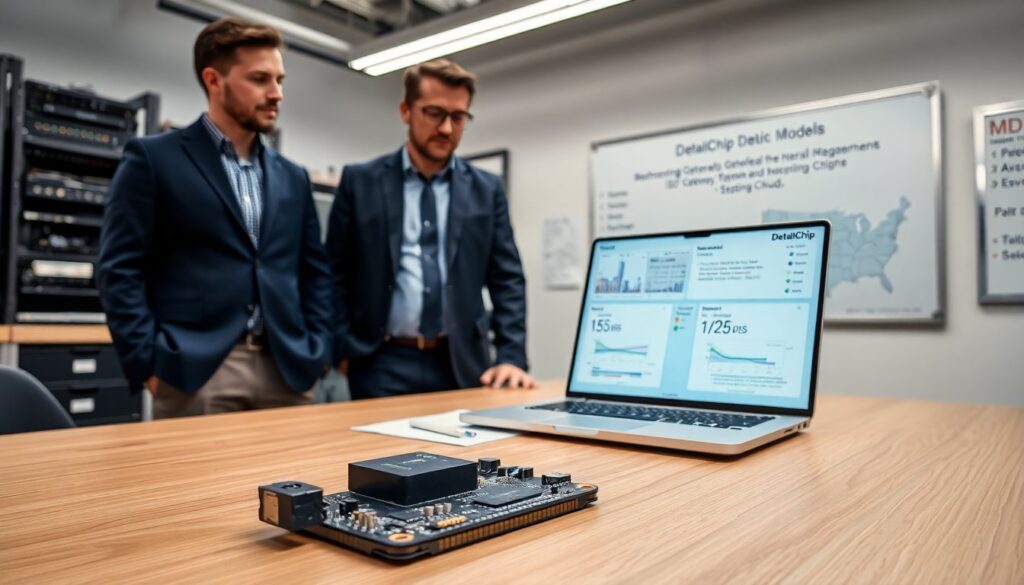
Zosgardroechew DetailChip Technology appears as a new edge processor for tight-latency workloads. It delivers high throughput and low power for field devices. The chip shifts inference and data reduction to device level. This shift cuts cloud cost and reduces round-trip delay. The guide explains what the technology does, where it fits, and which teams should test it.
Key Takeaways
- Zosgardroechew DetailChip Technology enables low-latency, on-device neural inference, reducing cloud costs and round-trip delays.
- The chip is ideal for applications like visual inspection, audio event detection, and predictive maintenance in edge devices.
- Its architecture combines a vector accelerator and low-power microcontroller for efficient, secure processing within tight power budgets.
- Deployment options include on-device, gateway, and hybrid cloud, allowing teams to balance connectivity, cost, and privacy needs.
- Security features like hardware root of trust and secure boot ensure device integrity and protect model data.
- Operational best practices include automated model validation, staged rollouts, and energy profile tracking to optimize fleet reliability and battery life.
What Zosgardroechew DetailChip Technology Is, Why It Matters, And Key Use Cases
Zosgardroechew DetailChip Technology is a silicon platform that runs neural models and signal processing at the edge. The chip runs optimized kernels, compresses telemetry, and enforces runtime isolation. Engineers design it for low-power cameras, factory sensors, and autonomous shuttles. Teams choose the chip when they need local inference, deterministic latency, and lower bandwidth.
Zosgardroechew DetailChip Technology matters because it moves computation off the cloud and into devices. The chip reduces round-trip time for decision tasks. It lowers data egress costs by sending only events and summaries. IT teams get faster alerts. Field teams get longer battery life.
Common use cases for Zosgardroechew DetailChip Technology include visual inspection, audio event detection, and predictive maintenance. In visual inspection, the chip runs defect classifiers and returns only defect metadata. In audio detection, it flags alarms and streams short clips instead of continuous audio. In predictive maintenance, it runs vibration models and sends anomaly scores. Each case reduces data volume and speeds response.
Vendors integrate Zosgardroechew DetailChip Technology into cameras, gateways, and embedded controllers. System integrators pick the chip for retrofit projects because they can swap a board without redesigning the whole device. Product managers pick the chip when they need clear service-cost trade-offs. Researchers use the chip to test real-world model drift and update policies on-device.
Core Architecture, Performance Characteristics, And Deployment Models
The core of Zosgardroechew DetailChip Technology pairs a vector accelerator with a low-power microcontroller. The accelerator runs quantized neural networks. The microcontroller handles scheduler tasks, device I/O, and secure boot. The chip includes dedicated memory banks for model weights and a DMA engine for sensor streams. This layout reduces memory contention and improves sustained throughput.
Performance characteristics for Zosgardroechew DetailChip Technology include single-digit millisecond inference for compact models and sustained multi-GOPS performance for parallel workloads. The chip consumes tens to hundreds of milliwatts depending on clock and voltage settings. System designers tune frequency to trade latency for energy. Benchmarks show the chip processes 1080p frames at reduced resolution for detection tasks while keeping power under typical battery budgets.
Deployment models for Zosgardroechew DetailChip Technology include on-device, gateway, and hybrid cloud modes. On-device mode runs models locally and sends events. Gateway mode aggregates multiple devices and performs batching. Hybrid cloud mode runs heavy training or large models in the cloud while the chip handles inference and prefiltering. Teams choose a deployment based on connectivity, cost, and privacy requirements.
The chip supports familiar toolchains and container-like packaging for models. Developers compile models to the chip’s runtime format and sign artifacts for secure updates. The toolchain includes profiling tools that measure latency, memory, and power. These tools help developers match model size to the chip’s constraints and predict fleet cost.
Security, Integration Checklist, And Implementation Considerations
Zosgardroechew DetailChip Technology includes a hardware root of trust and secure boot. The chip enforces signed firmware and blocks unauthorized code. It supports device attestation and encrypted storage for model weights. Security teams should include the chip in their asset inventory and register its keys in existing key management systems.
Integration checklist for Zosgardroechew DetailChip Technology covers firmware, model packaging, and network flows. First, verify secure boot and update channels. Second, validate model conversion and test quantized performance on representative inputs. Third, measure end-to-end latency from sensor sample to event emission. Fourth, test failure modes like power loss and network outage. Fifth, log events for audit and model drift monitoring.
Implementation considerations for Zosgardroechew DetailChip Technology include thermal limits, real-time scheduling, and over-the-air update cadence. Engineers must plan for heat dissipation in small enclosures. They must assign CPU time for housekeeping tasks to avoid inference jitter. They must choose update windows that match device uptime patterns and field constraints.
Operational practices improve outcomes with Zosgardroechew DetailChip Technology. Teams should automate model validation, deploy staged rollouts, and collect telemetry for drift detection. They should keep a rollback path and sign each release. They should track per-device energy profiles and adjust clock settings to extend battery life. These steps lower risk and keep fleets reliable.