
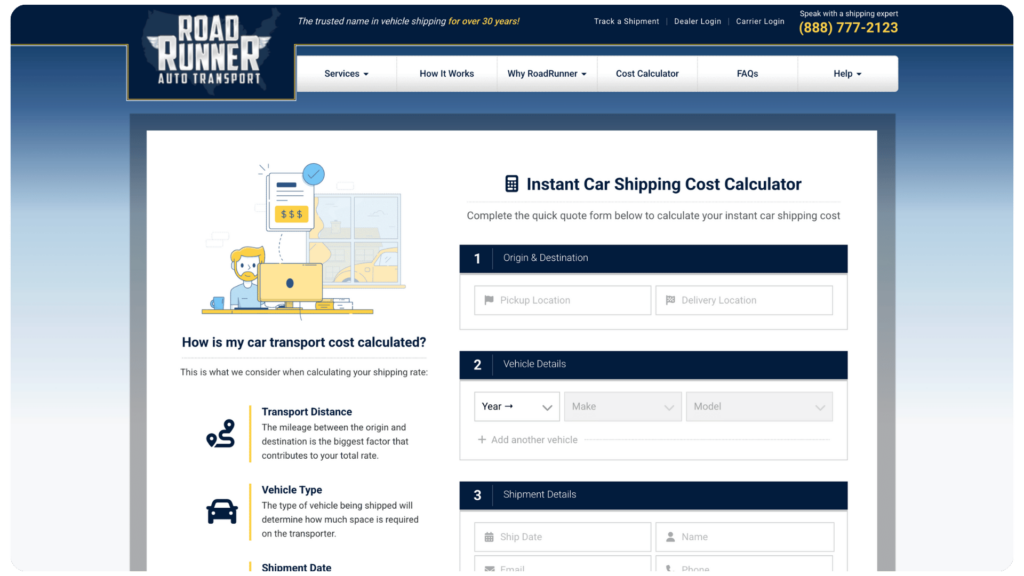
The question comes up the same way every time: how much does it cost to ship a car from one coast to the other?
The short answer is somewhere between $900 and $1,800 for most standard vehicles.
The real answer depends on about a dozen variables that shift your price up or down by hundreds of dollars.
Whether you’re requesting quotes through RoadRunner Auto Transport services or comparing multiple brokers on your own, the pricing follows patterns you can learn to read once you know what actually drives the numbers.
This is the full breakdown: what shapes your car shipping cost, how to evaluate a quote properly, and where the industry quietly charges you more than it should.
Distance Matters, But Not the Way You’d Think
Mileage is the starting point for any car shipping estimate, but the per-mile rate doesn’t scale linearly.
A 500-mile haul might run $1.00 per mile, while a 2,500-mile cross-country route drops to $0.40 or $0.50 per mile.
The total is obviously higher on longer distances, but the rate itself compresses significantly.
What really separates pricing is route popularity.
Shipping a sedan from Los Angeles to Chicago along the I-10 and I-40 corridors is cheaper than moving that same car from rural Montana to a small town in Vermont.
Carrier volume along major freight lanes like the I-95 Eastern Seaboard route keeps competition high and prices reasonable.
Remote pickup or delivery locations tack on $150 to $400 because the driver has to detour off their normal circuit, burning time and fuel for a single stop.
So when you’re trying to figure out how much it costs to ship a car, the origin-destination pair matters more than raw miles alone.
Vehicle Type Changes the Math
A Honda Civic doesn’t cost the same to ship as a Ford F-250 Super Duty.
Carriers price based on weight and dimensions because both directly affect how many vehicles fit on a trailer.
A standard open car hauler holds 7 to 10 vehicles, depending on size.
One oversized pickup takes the space of two sedans, and the carrier bills accordingly.
Here’s what typical cross-country ranges look like by vehicle class:
- Sedans and compacts (Toyota Camry, Honda Accord): $900–$1,300
- SUVs and crossovers (Jeep Grand Cherokee, Toyota 4Runner): $1,100–$1,500
- Full-size trucks and vans (RAM 1500, Chevrolet Suburban): $1,200–$1,800
- Luxury, exotic, or classic vehicles: $1,400–$2,500+ (enclosed transport recommended)
Non-running vehicles add another $100 to $300 because the driver needs a winch or additional equipment just to load them.
If you’re requesting a car shipping estimate for an inoperable vehicle, mention it upfront.
Leaving it out only delays the process and guarantees a price adjustment later.
Open vs. Enclosed Transport
This decision directly shapes your car shipping cost more than most people expect.
Open transport is the industry default.
Those multi-level car carriers you pass on the highway account for roughly 85% of all vehicle shipments in the United States.
It’s reliable, widely available, and priced competitively.
Enclosed transport uses a fully covered trailer that shields the vehicle from road debris, weather, and UV exposure.
It’s the standard choice for high-value vehicles like a Porsche 911 GT3, a classic Corvette Stingray, or anything you wouldn’t want exposed to five days of highway grime.
The trade-off is real, though.
Enclosed shipping typically runs 30% to 50% higher than open, and availability is tighter because fewer carriers operate enclosed trailers.
For a daily driver worth under $30,000, open transport is the practical call.
Damage rates on reputable open carriers are extremely low, and the savings go straight back in your pocket.
Seasonal Pricing and When to Book
The auto transport industry follows predictable seasonal cycles, and they affect every car shipping quote you receive.
Summer months, June through August, are peak season.
Snowbirds heading north, families relocating before the school year, and military PCS moves all stack up at once.
Prices during this window jump 20% to 30% above winter baselines.
January and February tend to be the cheapest months.
Demand drops sharply after the holidays, and carriers compete harder for loads.
If you have any flexibility on timing, booking a winter shipment can shave $200 to $400 off a cross-country move.
There’s also a late-fall spike driven by snowbird migration into Florida, Arizona, and Southern California.
Routes heading into those states get congested from October through December, pushing estimates higher on those specific lanes even while other corridors stay relatively calm.
Anyone requesting a car shipping estimate for a Sun Belt destination during Q4 should budget for the seasonal premium.
How Quotes Actually Work Behind the Scenes
Most auto transport companies don’t own fleets of trucks.
They function as brokers, connecting you with independent carriers through a centralized load board.
When you request a car shipping quote, the broker posts your shipment details (origin, destination, vehicle type, preferred dates) and carriers bid on the job.
This is where pricing gets nuanced. If your offered price sits at or above market rate, a carrier picks it up fast.
Price it too low, and your vehicle sits on the board for days or even weeks with no takers.
Reputable brokers price competitively from the start, which means your shipment gets matched to a carrier without unnecessary delays.
That balance between a fair price and fast pickup is what separates a smooth experience from the kind where you’re calling every two days asking why nothing’s happened.
Be cautious of any car shipping quote that undercuts everyone else by a wide margin.
A broker offering to move your SUV coast-to-coast for $500 is almost certainly lowballing to lock in your deposit, then calling back later to ask for more money once no carrier accepts the load at that rate.
It’s the single most common complaint in the industry, and it’s entirely avoidable if you understand how the system works.
Hidden Fees That Inflate the Final Number
A transparent company gives you a quote that covers door-to-door service, fuel surcharges, and standard liability insurance.
But not every quote is structured the same way.
These are the add-ons that catch people off guard:
- Inoperable vehicle surcharge: $100–$300 if your car doesn’t start or roll freely
- Expedited shipping premium: $200–$500 for guaranteed pickup within 24–48 hours
- Remote area fees: $150–$400 for locations far from major interstates
- Terminal fees: $50–$150 if using a depot instead of door-to-door delivery
- Cancellation fees: Some brokers charge once a carrier has been dispatched
The best way to protect yourself is simple: ask specifically what’s included before you commit.
A transparent car shipping estimate that’s slightly higher upfront almost always beats a bargain-basement number that balloons with surcharges after the fact.
Insurance and Liability Coverage
Every licensed auto transport carrier is required to carry cargo insurance under federal regulations enforced by the FMCSA (Federal Motor Carrier Safety Administration).
Standard coverage typically ranges from $100,000 to $250,000 per load, not per vehicle, which is more than sufficient for most standard cars.
If you’re shipping something high-value, like a $90,000 Mercedes-AMG GT, for instance, verify the carrier’s specific coverage limits and consider supplemental insurance through a third-party provider.
Some premium transport companies include higher coverage as part of their enclosed shipping service, which adds protection without requiring a separate policy.
Before your vehicle is loaded, you’ll complete a condition inspection with the driver.
This document s every existing scratch, dent, and ding on a Bill of Lading.
Take your own timestamped photos as well.
If anything happens during transit, this documentation is what makes or breaks an insurance claim.
Realistic Delivery Timelines
Cross-country auto transport, like New York to Los Angeles, typically takes 7 to 14 days from pickup to delivery.
That window accounts for driver rest requirements mandated by the DOT, multi-stop routes, and weather delays.
Shorter hauls move faster. A 500-mile shipment might arrive in 2 to 4 days.
Most carriers cover 300 to 500 miles daily, depending on their route density and how many vehicles they’re delivering along the way.
If your timeline is rigid, expedited shipping is available at a premium.
Standard shipping with a flexible pickup window of 3 to 7 days gives carriers room to slot your vehicle into an existing route, which directly lowers your car shipping cost.
Flexibility is one of the few levers you fully control.
Practical Ways to Lower What You Pay
You can’t control diesel prices or seasonal demand, but several decisions sit entirely in your hands:
Be flexible with dates. A pickup window of 5 to 7 days instead of one specific date gives carriers more scheduling options. That flexibility often translates to a noticeably lower car shipping quote because the driver can build your stop into a route they’re already running.
Ship during off-peak months. January, February, and early March consistently offer the best pricing across most U.S. routes.
Consider terminal-to-terminal service. If a carrier depot exists near both your origin and destination, using it instead of door-to-door can save $100 to $200. Less convenient, but the savings are tangible.
Book two to three weeks ahead. Last-minute shipments carry a premium because carriers charge more to squeeze a vehicle into an already-planned load. Advance booking is the sweet spot for balancing cost and carrier availability.
Get multiple quotes. Three to five estimates from different brokers gives you a reliable read on current market pricing. If one number looks dramatically different from the rest, high or low, that’s your signal to ask questions.
So, How Much Does It Cost to Ship a Car?
The national average for a coast-to-coast shipment lands around $1,100 to $1,500 for a standard sedan on an open carrier.
SUVs and trucks push that higher.
Enclosed transport adds another 30% to 50%.
Seasonal swings, route demand, and your flexibility on dates shift the number in either direction.
The smartest move is to gather several quotes, compare what’s actually included in each car shipping estimate, and read reviews on platforms like the Better Business Bureau and Trustpilot before committing.
Don’t chase the lowest price.
Chase the company that prices honestly, communicates clearly throughout the process, and has a documented track record of delivering vehicles on time and without damage.
That’s what determines whether shipping your car across the country is a painless transaction or a weeks-long headache.
The cost matters, but the experience matters just as much.